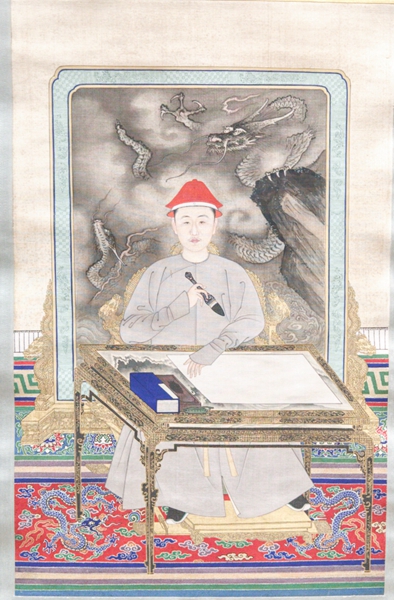
Emperor Kangxi
康熙帝
- 分类: 历史脉络
- ID: 1869045733427859457
Home CategoryHistoryEmperor KangxiPlay6 minsThe Emperor Kangxi, born Aisin Gioro Xuanye in 1654, was the fourth emperor of the Qing Dynasty, ruling from 1662 to 1722. Ascending the throne at age eight, his reign is among the longest in Chinese history.ShareCatalogue1. Early Life and Ascension2. Governance and Achievements3. Cultural Contributions4. Religious and Philosophical Influence5. Architectural and Artistic Legacy6. Military Campaigns and Expansion7. Personal Life and Legacy8. Final Years and Succession
Early Life and Ascension
The Emperor Kangxi, born Aisin Gioro Xuanye on May 4, 1654, was the fourth emperor of the Qing Dynasty (1644-1911), ruling from 1662 to 1722. Ascending the throne at the age of eight after the death of his father, the Emperor Shunzhi, Kangxi's reign is one of the longest in Chinese history. His early years as emperor were marked by a regency led by his grandmother, Empress Dowager Xiaozhuang, and the powerful minister Sonin. However, Kangxi was quick to assert his influence, taking control of the government by 1667, when he declared the end of his regency.
Governance and Achievements
Kangxi's reign is often heralded as a time of prosperity and consolidation for China. He implemented various reforms to stabilize the empire's economy and reduce corruption. His reign is particularly noted for the suppression of the Revolt of the Three Feudatories, which solidified Qing control over southern China.
Under his rule, Kangxi improved diplomatic relations with Russia through the Treaty of Nerchinsk in 1689, which settled border disputes and opened trade routes. Domestically, he promoted agriculture, reduced taxes, and established a system of flood control, contributing to an era of relative peace and economic growth.
Cultural Contributions
The Emperor Kangxi was a patron of the arts and sciences, fostering a cultural renaissance during his reign. His interest in Western sciences led to the establishment of the Jesuit mission in Beijing, which introduced European scientific knowledge, including astronomy and mathematics, to the Qing court. Kangxi himself was a skilled calligrapher, and his calligraphy is still admired today. His endorsement of the Kangxi Dictionary, an authoritative compilation of Chinese characters, played a significant role in standardizing the Chinese language.
Religious and Philosophical Influence
Kangxi was known for his religious tolerance, particularly towards Christianity. He allowed Jesuits to operate within China, appreciating their knowledge of Western science, which he deemed beneficial for the empire.
His reign saw the production of the Kangxi Dictionary, a comprehensive work that remains one of the most significant contributions to Chinese lexicography.
In philosophy, Kangxi supported Confucianism, endorsing the Confucian classics and integrating Confucian principles into governance. This resulted in a more centralized and bureaucratic system that reinforced the emperor's authority.
Architectural and Artistic Legacy
Kangxi's reign witnessed the flourishing of Qing art and architecture. He initiated the construction of the Mountain Resort in Chengde, which became a summer retreat and a symbol of Qing architectural accomplishment, blending Han Chinese, Mongol, and Tibetan styles. The Kangxi period is also noted for the development of falangcai, a unique style of porcelain enameling. An imperial bowl from this period, known for its "double lotus" design, exemplifies the exquisite craftsmanship achieved during his reign.
Kangxi's contributions to art extended beyond architecture and porcelain. He appreciated calligraphy and traditional Chinese painting, encouraging the work of artists who would come to define the era. The famous "Four Wangs," a group of painters known for their landscapes, flourished during his time, reflecting the harmonious blend of classical styles and contemporary innovation.
Military Campaigns and Expansion
Kangxi's military campaigns were pivotal in expanding and consolidating Qing control. His suppression of the Revolt of the Three Feudatories (1673-1681) was a decisive victory that brought stability to southern China. His campaigns in the northwest extended Qing influence into Mongolia and Central Asia, solidifying the empire's frontiers.
Kangxi's strategies were marked by his ability to integrate different ethnic groups into the Qing military structure. His incorporation of Mongol troops and the establishment of the Eight Banners system allowed for effective governance and control over the vast territories.
Personal Life and Legacy
Kangxi was a deeply personal emperor who maintained a rigorous schedule, often rising before dawn to attend to state affairs. He was known for his intellectual curiosity and had a deep interest in philosophy, mathematics, and natural sciences. His personal diaries and letters reveal a ruler dedicated to the welfare of his people and the strength of his empire.
His legacy is complex; he is remembered as a formidable ruler who consolidated Qing power and expanded its territories, yet his reign also set the stage for future challenges. Despite these challenges, Kangxi's reign is often regarded as a golden age in Chinese history, characterized by political stability, cultural flourishing, and economic prosperity.
Final Years and Succession
Kangxi's later years were marked by family strife and the succession crisis. His numerous sons vied for power, leading to political intrigue and tension within the court. Kangxi's decision to keep the succession secret until his death led to intense speculation and conflict. He eventually appointed his fourth son, Yinzhen, as his successor, who ascended the throne as the Yongzheng Emperor.
Kangxi's death in 1722 marked the end of an era. His achievements in governance, culture, and military expansion had a lasting impact on China, cementing his legacy as one of the greatest Chinese emperors. His reign is often studied for its contributions to the Qing Dynasty's strength and longevity, as well as its cultural and scientific advancements. Article reference1. Ice pops of Prince Kung’s Palace Museum. en.pgm.org.cn. 20232. Rare Qing Dynasty enamel bowl auctioned for HK$87.2mln. chinadaily.com.cn. 20193. Mountain Resort and its Outlying Temples. chinaservicesinfo.com. 2019Photo Gallery(3 pictures)CategoriesHistoryTagHistorical FiguresAncient Chinese HistoryRelatedYuanmingyuan Park (Old Summer Palace)Mountain Resort and its outlying temples, ChengdeFerdinand VerbiestThe Deer and the CauldronCatalogue1. Early Life and Ascension2. Governance and Achievements3. Cultural Contributions4. Religious and Philosophical Influence5. Architectural and Artistic Legacy6. Military Campaigns and Expansion7. Personal Life and Legacy8. Final Years and Succession- - - []








